Installation Requirements KNX Cable
Professional guide to KNX/EIB bus cable routing and installation. Technical requirements, standards and best practices to ensure reliable operation of your building automation system.
Core Installation Requirements
Following these requirements ensures reliable and long-lasting operation of your KNX system
- Total length of all segments ≤ 1000 m
- Distance between two devices ≤ 700 m
- Distance from power supply to device ≤ 350 m
- Minimum 4 mm from 230V power cables
- Use separate cable ducts
- Crossings only at 90° angle
- Ground cable shield on one side only
- Avoid parallel routing with power lines
- Use certified KNX cable
- Operating temperature: -5°C to +45°C
- Humidity: up to 93% non-condensing
- IP20 protection for indoor installation
- ✕Do not route KNX cable in the same duct as power cables
- ✕Do not use ordinary twisted-pair cable instead of certified KNX cable
- ✕Ring topologies within a line are strictly forbidden
- ✓Use colour coding: red (+), black (−)
- ✓Leave cable slack in junction boxes
- ✓Document all connections and topology
- ✓Check polarity before connecting devices
Technical Specifications
Detailed cable characteristics and KNX/EIB system parameters
Cable Types
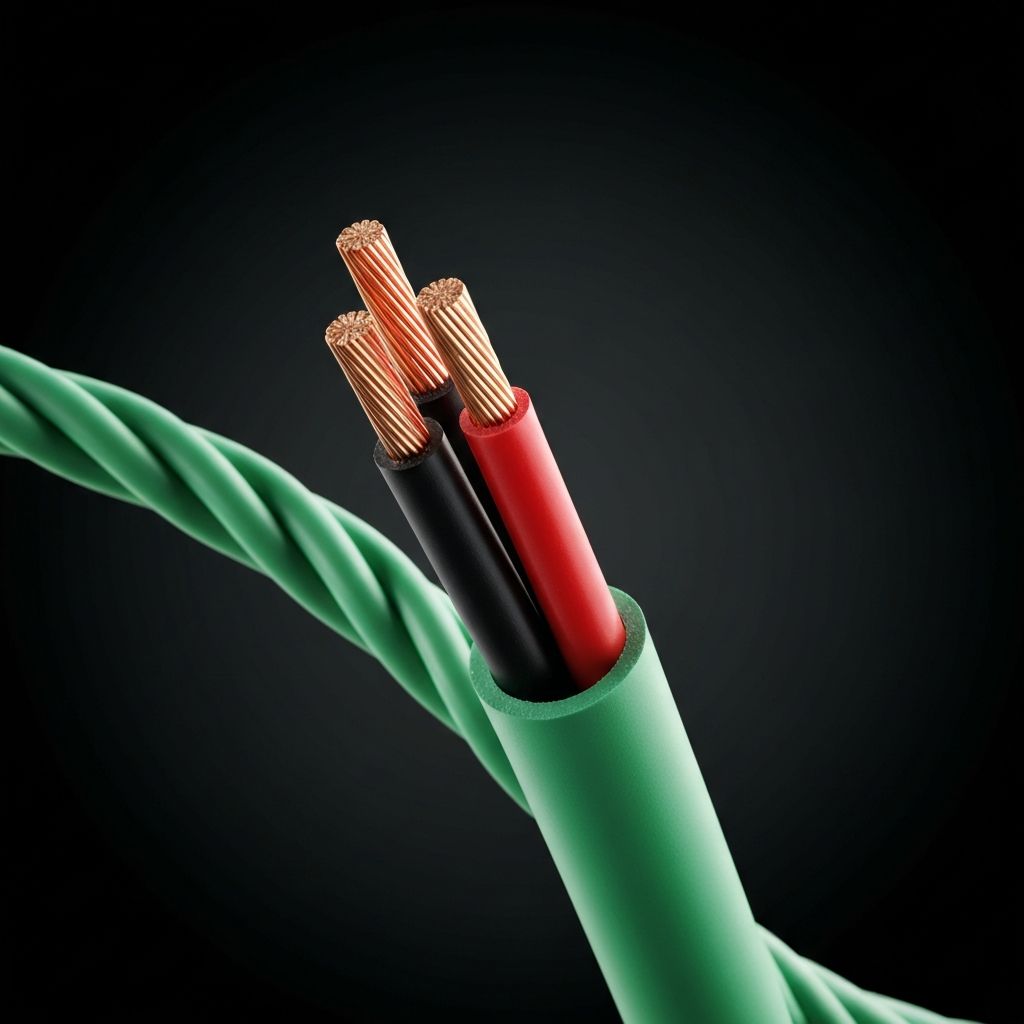
Primary cable for indoor installation
Cores
2 пары × 0.8 мм
Outer diameter
6.5 мм
Resistance
< 72 Ом/км
Insulation voltage
4 кВ
For installation in high-interference environments
Cores
2 пары × 0.8 мм
Shield
Алюминиевая фольга
Outer diameter
7.0 мм
Insulation voltage
4 кВ
Red
+UB (positive)
Black
−UB (negative)
Yellow
Reserve / SELV
White
Reserve / SELV
Supported Topologies
KNX supports free topology without closed loops
Devices connected in series
Advantages:
- +Simple installation
- +Minimal cable use
Disadvantages:
- −Break affects entire line
All devices connected to a central point
Advantages:
- +Device independence
- +Easy diagnostics
Disadvantages:
- −More cable required
Combination of line and star topology
Advantages:
- +Flexibility
- +Optimal cable use
Disadvantages:
- −More complex planning
Important: Ring topology is prohibited
Ring connections (closed loops) are strictly forbidden in KNX. They cause telegram collisions and system failures. Always verify the absence of closed loops before commissioning.
Need a Consultation?
Our specialists will help with KNX system design and installation
Virasmart SIA
Building Automation Systems
Our Services:
- KNX system design
- Installation & commissioning
- Programming & integration
- Technical maintenance
- Consulting & training